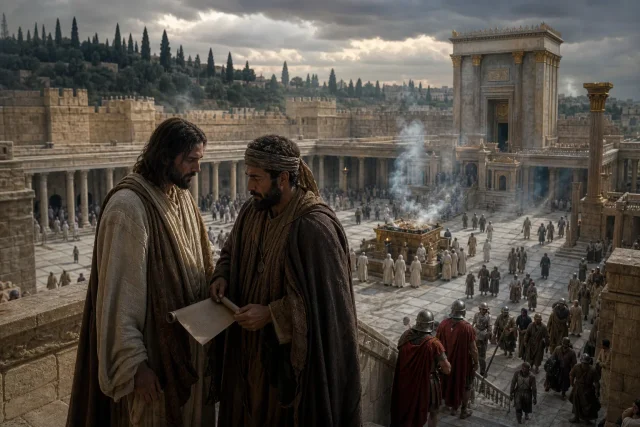
Growing in Faith Through Christian Mentoring

Christian Mentoring in the Presence of Jesus
When Everything Falls Apart
Your phone lights up at 6:12 a.m. while the coffee machine sputters on a cracked kitchen counter, and before the first sip hits your mouth, your supervisor’s email lands with corporate politeness and surgical force: budget cuts, position eliminated, laptop return instructions attached. Outside, rain needles the apartment window, traffic hisses on wet asphalt, and your son is asking where his field trip money is while your stomach drops hard enough to make the room tilt. You stand there in yesterday’s sweatshirt, one sock damp from stepping in dog water, staring at a glowing screen that suddenly feels heavier than stone.
By noon, the crisis multiplies. The pharmacy app pings with a refill delay because insurance changed, your wife sends a text with no emojis saying her mother’s biopsy came back concerning, and your brother leaves a voicemail asking why you still have not paid him back. Picture yourself in the grocery store under those cold fluorescent lights, pricing eggs with a calculator open on your phone, hearing a toddler cry three aisles over, trying not to snap when somebody blocks the cart lane comparing oat milk brands. This is where Christian mentoring starts, not in polished moments, but in the wreckage where somebody needs another believer to stand close and speak the truth of Christ.
I know that terrain more than I wish I did. At twenty, sitting in a college library basement with bad carpet and worse theology in my head, I nearly lost my faith. I had professors slicing at Scripture, family pressure to keep working full-time, and a private fear that maybe I had inherited religion without solid ground beneath it. A campus mentor named Raul did not hand me clichés; he met me after shifts at a burrito place, listened while I unloaded every question, and kept bringing me back to Jesus as a real person in real history, crucified under a Roman governor whose name sits in stone.
Mentoring matters because collapse is rarely dramatic for long; it becomes ordinary. It moves into traffic jams where irritation spills onto your kids, into neighborhood conversations where you fake strength, into doctor waiting rooms where silence buzzes louder than the television mounted in the corner. News headlines carry layoffs, rising rent, and another shooting three blocks from a school, while private grief keeps unfolding off-camera in bedrooms, break rooms, and parked cars. In that kind of world, Christian mentoring becomes one wounded believer helping another keep hold of Jesus when everything in the room says to let go.
Because of this...
Ancient Cries Timeless Pain
History comes alive when you realize the ache in your chest is not new. Picture yourself walking through ancient ash layers at an archaeological site, brushing dirt from a broken jar handle, and sensing that human tears have soaked this ground for thousands of years. The clothes change, the tools change, the empires rise and collapse, yet the human face in crisis looks hauntingly familiar. Christian mentoring is not a trendy ministry strategy; it grows from the long witness of people who needed faithful voices beside them when life split open.
Job sits in the rubble after losing children, wealth, and health, and his grief does not arrive tidy or sanitized. He scrapes his skin with broken pottery, the kind of shard you can still see in museum cases, and his friends first do the right thing by sitting silent in the dust. Then they begin talking too quickly, assigning formulas to suffering, and they become a warning to every mentor who wants easy answers. Job 2:13 says,
“So they sat down with him upon the ground seven days and seven nights, and none spake a word unto him: for they saw that his grief was very great.”
David knows betrayal in the bloodstream. His own son Absalom steals hearts in the city gate, and the king flees Jerusalem barefoot, weeping as he climbs the Mount of Olives. Picture the scene cinematically: olive trees twisting in gray morning light, sandals slapping dirt, loyal friends glancing back toward the city walls, and a father carrying both political disaster and personal heartbreak. Psalm 55:12-14 says,
“For it was not an enemy that reproached me; then I could have borne it: neither was it he that hated me that did magnify himself against me; then I would have hid myself from him: But it was thou, a man mine equal, my guide, and mine acquaintance. We took sweet counsel together, and walked unto the house of God in company.”
Hannah carries another kind of pain, the monthly ache of unanswered prayer and public humiliation. In a culture where barrenness brought social shame, she walks into worship with lips trembling and no sound coming out, so broken that Eli mistakes anguish for drunkenness. First Samuel 1 is raw
Continue Your Bible Study
Explore more lessons and deepen your understanding of scripture
View All Lessons Ask AI a Question